

Introduction
Many consumers hold the misconception that a higher vibration frequency automatically delivers better cleaning results. In reality, effective oral care is a delicate balance between plaque removal and the protection of vulnerable gum tissue and tooth enamel.
Chasing excessively high frequencies brings minimal improvements to cleaning, while significantly raising the risk of soft tissue irritation, receding gums, and enamel wear.
Rotating and sonic swing vibrations are the two mainstream designs in the market, each delivering distinct experiences. Supported by clinical dental studies and findings from global authoritative dental organizations, no single frequency or mechanical design works perfectly for everyone. This article objectively analyzes the strengths and limitations of mainstream technologies to help people with delicate, sensitive gums make a well-informed, clinically sound choice.

Vibration Frequency: Why Higher Does Not Equal Better
Many brands market ultra-high vibration frequencies (often exceeding 40,000 strokes per minute) as their core selling point. However, clinical data tells a different story.
The Law of Diminishing Returns in Oral Tech
According to systematic reviews from the Cochrane Library and long-term clinical observations by leading global dental institutions, once vibration frequency crosses the 40,000 strokes/min threshold:
- The improvement rate of plaque removal drops below 5%.
- The extra cleaning benefit becomes practically negligible.
- Intense continuous vibration significantly increases the risk of gum inflammation, bleeding, and dental pulp irritation.
The Clinically Proven "Sweet Spot"
For users with sensitive gums, thin gingival tissue, worn enamel, or mild periodontal issues, 22,000 to 28,000 strokes per minute stands as the golden range that perfectly balances gentleness and effective cleaning.
- [ Less than 20,000 SPM ] → Insufficient Plaque Removal
- [ 22,000 - 28,000 SPM ] → THE GOLDEN SWEET SPOT (Gentle + Effective)
- [ More than 40,000 SPM ] → High Risk of Enamel Wear & Gum Recession
Controlled trials conducted by international dental schools verify that vibration within this moderate-low range generates optimal acoustic energy to disrupt plaque without impacting fragile gum capillaries. This fully meets the daily plaque removal standards set by the American Dental Association (ADA).
⚠️ Note: Compared to high-load brushes, products in this golden frequency range require a standardized, slightly longer brushing routine to achieve peak results, rather than a rushed 1-minute scrub. Long-term clinical research confirms that excessive mechanical force and ultra-high vibration are major contributors to gradual gingival recession and enamel micro-wear (Heasman et al., 2015).

Rotating vs. Swing Vibration: A Technical Comparison
To understand which mechanical design suits sensitive teeth, we must weigh the pros and cons of the two industry standards.
Rotating Electric Toothbrush
The rotating structure is a mature, classic mechanical design. It excels at heavy-duty surface cleaning and fixes common human errors like uneven hand pressure or irregular motion. However, restricted by its physical friction mechanism, it struggles to clean thoroughly in the gingival sulcus (gum line) and interdental gaps, making it less than ideal for targeted periodontal care.
Swing Vibration Electric Toothbrush
Traditional sonic swing toothbrushes are engineered to follow the Bass Method (universally recommended by dental associations). By sweeping horizontally, the brush head fits closely against the tooth contours.
According to an 8-week randomized controlled trial comparing mainstream brushing mechanisms, sonic swing motion performs better at removing hidden plaque along gingival sulci with lower gum irritation, compared with traditional rotating-oscillating designs (Grender et al., 2020).
However, clinical feedback shows that an excessively wide swing creates persistent, aggressive shear force along fragile gum lines, sacrificing daily comfort for deep cleaning.
The Next-Gen Solution: Hybrid Engineering for Sensitive Mouths
As proven by dental research, standalone legacy technologies carry inherent drawbacks. Ultra-high frequency carries potential oral health risks; moderate frequency can be less efficient in tight spaces; rotating designs lack deep gap coverage; and large swing designs trigger gum bleeding.
The ideal solution requires integrating optimal biological parameters into a single, well-rounded design—striking a perfect balance between professional cleaning and clinical-grade gum protection.
1. 22,000 Strokes/Min Golden Frequency
By capping the motor at 22,000 strokes per minute, this approach eliminates the enamel micro-abrasions and vascular irritation triggered by high-frequency strain. It complies precisely with the low-load cleaning standards recommended by international dental clinics for sensitive oral environments (Yaacob et al., 2014).
2. 12° Micro-Swing Architecture
Abandoning the aggressive wide angles of conventional sonic brushes, a refined 12° micro-swing motion is applied. This gentle sweeping keeps the bristles perfectly aligned with the core principles of the Bass Method—sweeping away plaque along the gum lines smoothly without bruising or compressing delicate soft tissues.
Clinical periodontology studies confirm that limited micro-amplitude swinging most closely simulates professional instructed manual brushing, delivering fluid dynamic cleaning without gingival compression (Van der Weijden & Slot, 2015).
3. Medical-Grade Ultra-Soft Contact Structure
Equipped with 0.01mm ultra-soft tapered bristles paired with a fully wrapped soft rubber brush head, this design drastically cuts down the kinetic impact against teeth. It shields enamel from accidental plastic head strikes and prevents gum recession during daily use.
4. Breakthrough Airjet Cleaning Technology
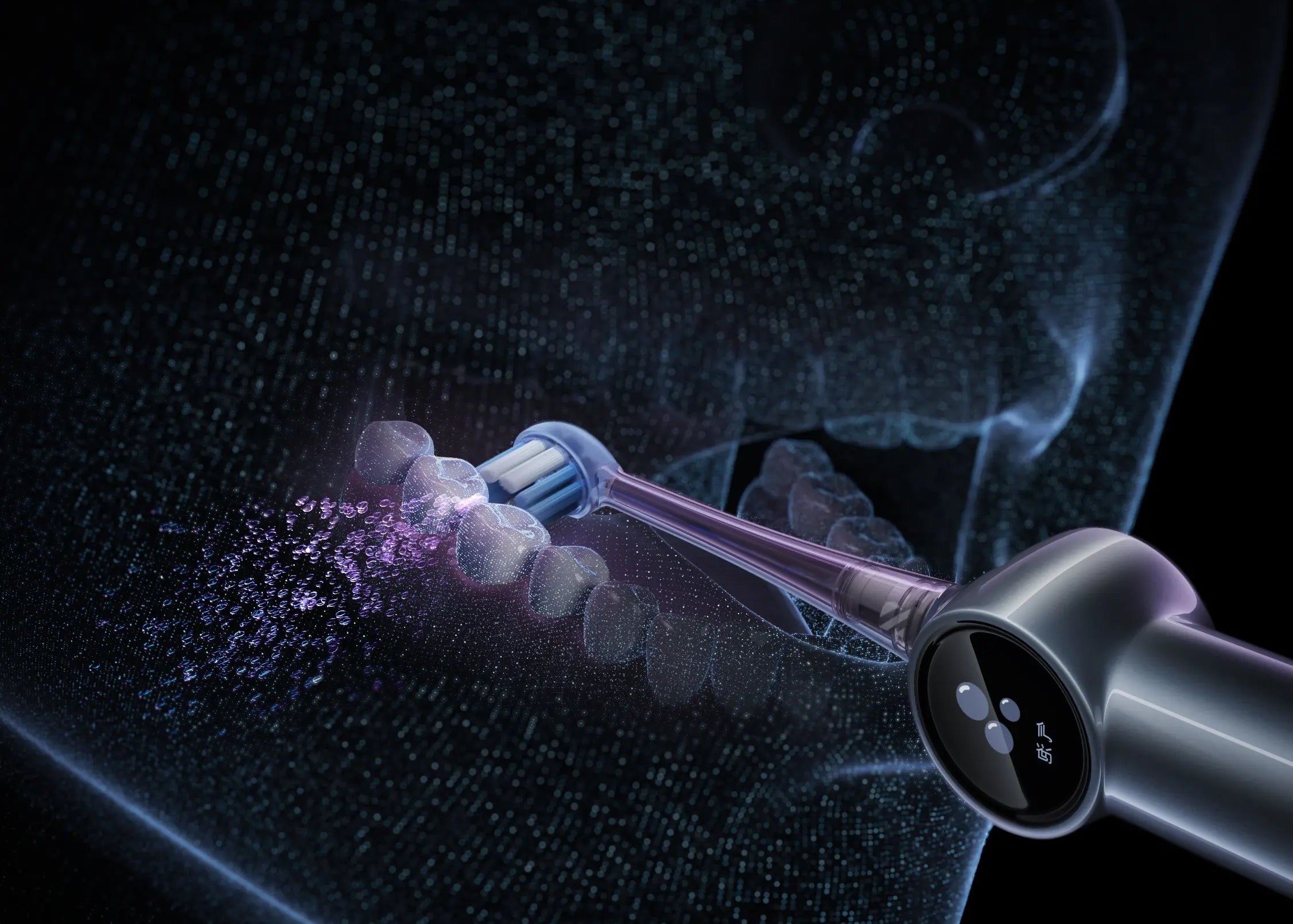
To compensate for the lower mechanical frequency in tight interdental areas, exclusive Airjet Technology is introduced. Moving beyond pure mechanical scrubbing, it deploys localized, high-density micro-airflow to reach deep into interdental gaps and the gingival sulcus.
Dental hygiene research verifies that micro-airflow and hydrodynamic non-contact cleaning effectively removes interdental plaque in blind spots, solving the physical limitation where traditional bristles cannot reach narrow gaps (Sälzer et al., 2016).
This creates a non-contact cleaning dynamic that flushes out hidden food debris and micro-plaque from blind spots—delivering an elite clean without putting a single ounce of physical pressure on sensitive gums.
Conclusion
Authoritative clinical studies have repeatedly confirmed that premium oral care never relies on blindly escalating motor speeds or adopting aggressive mechanical friction. Instead, it relies on intelligent, balanced parameter engineering.
The combination of a 22,000 strokes/min golden frequency, a 12° micro-swing, clinical-grade ultra-soft bristles, and hydro-dynamic Airjet technology elegantly solves the ultimate sensitive gum paradox. It avoids the trauma caused by over-powered sonic brushes while compensating for the spatial limitations of rotating brushes.
For users dealing with tooth sensitivity, receding gums, localized inflammation, or those simply seeking a safer, long-term approach to oral longevity, this hybrid design represents the absolute optimal standard for daily oral hygiene.
💡 Ready to upgrade your oral health routine without the pain?
👉 Explore the Airjet Series — Clinical Care for Sensitive Gums
References
- Yaacob, M., et al. (2014). Powered versus manual toothbrushing for oral health. Cochrane Database of Systematic Reviews, 6.
- Grender, J., et al. (2020). An 8-week randomized controlled trial comparing the effect of a novel sonic toothbrush versus an oscillating-rotating toothbrush on plaque and gingivitis. International Journal of Dental Hygiene, 18(4), 346–354.
- Van der Weijden, F. A., & Slot, D. E. (2015). Efficacy of automatic powered toothbrushes compared to manual toothbrushes during standard and instructed brushing periods. Journal of Clinical Periodontology, 42(S17).
- Heasman, P. A., et al. (2015). Toothbrushing and gingival recession: an overview of systematic reviews. Journal of Clinical Periodontology, 42(3), 205–217.
- Sälzer, S., et al. (2016). Efficacy of interdental cleaning devices in reducing plaque and gingivitis in adults. International Journal of Dental Hygiene, 13(2), 71–81.